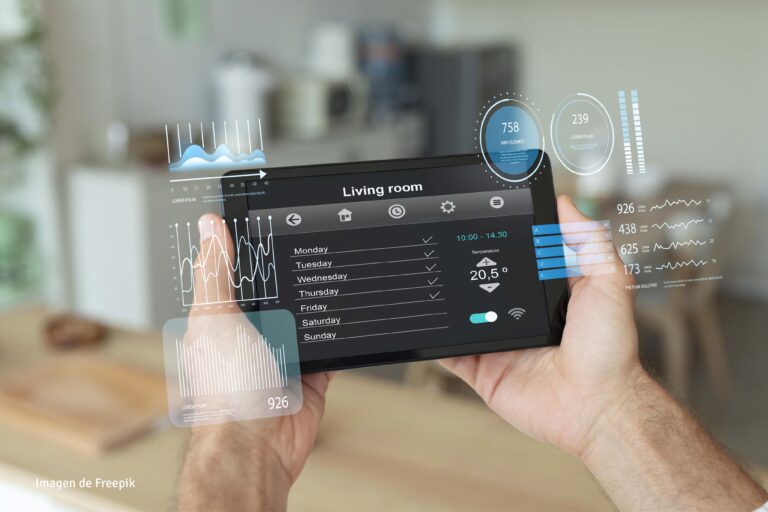
Efficient management with BMS system: keys to a sustainable and connected building
What is a BMS system?
Building management or automation systems, known as Building Management Systems (BMS), are computer systems that automate and control various mechanisms in a building. These mechanisms include lighting, HVAC (heating, ventilation and air conditioning), surveillance systems, fire alarms, energy management, irrigation systems, waste management, access control, and others.
The BMS makes it possible to automate and control these systems in a centralized manner, facilitating intelligent and efficient management of buildings.
How does a BMS system work?
The operation of a BMS system depends on certain components that ensure its proper performance:
Data Collection Points: these sensors allow measuring parameters such as light levels, temperature, humidity, air quality, presence of people, among others.
Actuators: carry out actions based on the signals that the BMS sends. They are capable of operating valves, controlling lighting, regulating thermostats and managing various electrical and mechanical equipment.
Controllers: receive data and issue commands to all systems that are connected to maintain the desired conditions.
Central server: equipped with management software that collects and processes information from all collection points and controllers. From this interface, you can make configurations, program automatic actions, analyze historical data and evaluate system performance.
Communication network: The BMS system uses a communication network to connect all sensors and control units. This network, which can be both wired and wireless, facilitates the transmission of data and commands in real time.
Thanks to these components, the BMS system allows you to automate routine tasks such as lighting control according to occupancy, in addition to advanced monitoring of the building and generating alerts in the event of faults or critical events.
Advantages of a BMS system
Implementing a BMS system in a building offers multiple advantages:
Efficient use of energy: optimizes energy consumption by adjusting systems such as HVAC and lighting according to real environmental needs and conditions, resulting in a reduction in associated energy costs, contributing to sustainability.
Efficient use of water: manages the flow of water in the building and makes it possible to detect leaks early.
Centralized control: makes it possible to monitor and manage building systems from one place, simplifying operation and maintenance.
Lowers operating costs: by reducing the waste of energy and resources, building efficiency is optimized.
Extends the useful life of assets: by detecting technical faults early and continuously monitoring systems and equipment.
Improve security: by integrating security systems, it facilitates an agile response to emergencies.
Improves occupant comfort and well-being: when adjusting environmental conditions.
Compliance with environmental standards and certifications: by providing detailed information on energy efficiency and resource management.
Flexible and scalable: adapts to different types of buildings and can be expanded as needed.
The BMS system and sustainability
By efficiently managing the use of renewable resources and energies, and by contributing to improving air quality and the indoor environment, the BMS system not only optimizes the operation of the building, but also aligns with the objectives of sustainability and reduction of environmental impact associated with certifications such as LEED or BREEAM.