Globally, our linear systems of extracting, manufacturing and discarding have us heading towards an environmental, social and economic crisis, due to the use of materials and products that are dangerously unsustainable.
In addition to using renewable energy and energy efficiency measures in the built environment, the choice of sustainable building materials is also crucial to achieving climate objectives.
The essential principles of a circular economy for the built environment include:
A circular building optimizes the use of resources while minimizing waste throughout its life cycle. Its design, operation and dismantling increase in value over time by:
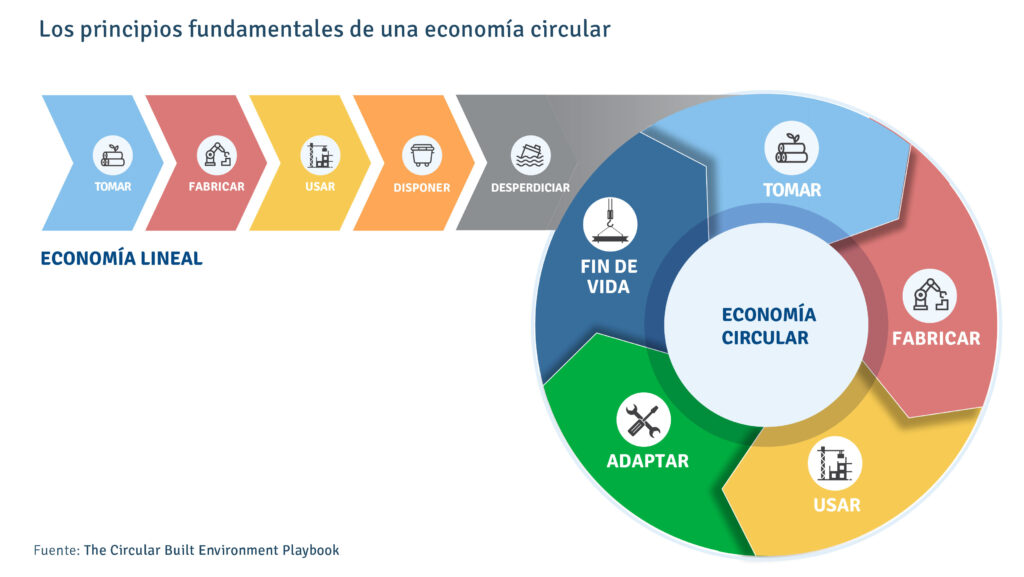
Unlike linear economic models, in which resources are discarded at the end of their first functional use, a circular economy maximizes resource utilization and minimizes waste throughout their entire life cycle.
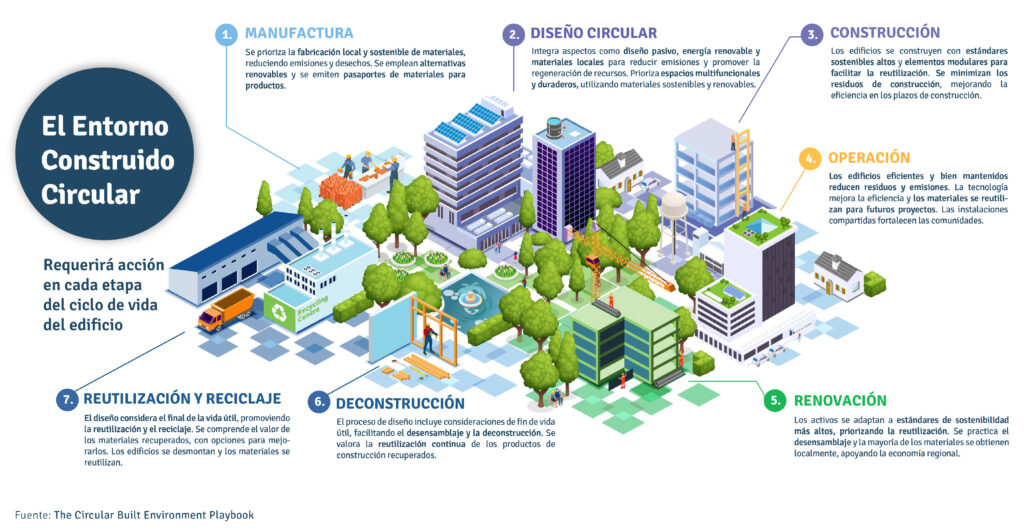
During the phase of manufacturing, local, alternative and reused materials must be used, especially those recovered from the demolition of buildings. It is a priority to use renewable energy sources and to manage natural resources efficiently.
In the phase of layout, it is crucial to prioritize energy efficiency through passive design strategies, as well as to promote the generation and use of renewable energy. In addition, it is essential to prefer local, reused or alternative materials. The design must incorporate facilities for maintenance, disassembly and dismantling.
During the phase of construction, construction methods with low incorporated carbon are applied, such as modular construction, and high performance standards are established for waste management. It is also a priority to use sustainable materials and products throughout the process.
In the phase Operational or use, buildings must be properly maintained, which extends the useful life of assets and their components. Waste generation is minimized and natural capital is restored and protected.
In the stage of upgrading or adaptation, all assets must be upgraded to higher sustainability standards. Priority is given to reuse rather than demolition.
When you arrive at the end of its useful life, it is essential to focus on carrying out a complete disassembly and deconstruction, thus allowing all construction materials, products and components of the building to be reused. In this way, it seeks to avoid demolition and the shipment of building components to landfills.
Moving to a circular economy in the built environment will only be possible through urgent and coordinated action by all sectors of society. Especially, through public sector regulatory enforcement and private sector leadership.
Source: The Circular Built Environment Playbook by WorldGBC
Leaf Global. Copyright © 2026. All rights reserved.